
Balls
My delayed thoughts on Marty Supreme

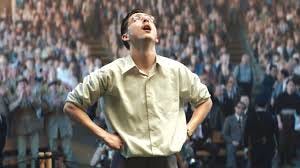
As some of you may have noticed, I have not written anything about Marty Supreme as of yet and there is a simple reason for that—I didn’t much care for it and had no particular urge to delve deep into my irritation with a film that had become a cause celebre with the most obnoxious legions of film bros even before it had officially opened. However, now that it has officially gone on to become one of the most talked-about films of the holiday season , receiving a number of raves—some even coming from people whose views I respect—and an apparent box-office hit to boot, not to mention the nudges I have received from people regarding the lack of a review, I have decided to finally sit down and offer up a few words about why I happen to think that it sucks the runniest of eggs.
The film, as many of you already know, is a crackpot epic set in the early 50s and centered around Marty Mauser (Timothy Chalamet), a wildly self-absorbed motormouth who has dreams of conquering the world via his skills at the then-rising sport of table tennis and will not let anything get in the way of demonstrating his greatness to the world, whether they want it or not. He plans to prove this by competing in the championships in England, where he cons his way into a luxury hotel suite, seduces a retired movie star Kay Stone (Gwyneth Paltrow) while trying to lure her pen magnate husband (Shark Tank’s Kevin O’Leary) into a sponsorship deal and makes outrageous statements to the press destined to call further attention to himself. What he doesn’t do, however, is actually win the final match against the Japanese champion (Koto Kawaguchi) but instead of licking his wounds after returning home, he becomes hellbent on scraping together enough money to go to Japan for a rematch, which leads him on a series of misadventures that find him leaving plenty of bodies, real and metaphorical, in his wake. Further complications arise in the form of Rachel (Odessa A’zion), a childhood friend whom he has knocked up even though she is married to another guy and who proves to be almost as determined to get what she wants as he is, and a fearsome local gangster (Abel Ferrara. . .yes, Abel Ferrara) whom he crosses paths with and unwisely tries to pull a scam on involving the mobster’s beloved pet dog.
In essence, Marty Supreme is basically a dark version of the traditional narrative of an ambitious young man willing to do whatever it takes in order to become a success in the world and the unexpected twists and turns he encounters along the way—a concept that has fueled fascinating and intriguing works ranging from Barry Lyndon to The Apprenticeship of Duddy Kravitz to the Brian De Palma version of Scarface. Here, Josh Safdie, making his first solo film since separating from brother Benny (who recently came up with his own riff on the sports movie genre with the already-forgotten The Smashing Machine), and co-writer Ronald Bronstein, have created a particularly odious variation on this theme, one that seems more inspired by one of the silliest variations on this theme, the 1966 camp classic The Oscar, in which Stephen Boyd played a callow actor willing to destroy lives in order to achieve fame and the titular award and mowed down any of the bizarrely assembled supporting players (who ranged from Jill St. John to Milton Berle to Tony Bennett) who got in his way. If you think I am reaching, consider the fact that both movies involves scenes where a complete novice witnesses actors rehearsing scenes involving the handling of a knife and impulsively jump on the stage in order to show them how it is done.
Although The Oscar is easily one of the worst films to ever go before the cameras, the histrionic end results are still watchable in a campy way, which is more than I can say for the relentless monotony of Marty Supreme. As it hurtles from incident to incident, it never seems to know what kind of story it is trying to tell and flits between being a serious drama, a satire, a thriller, a doomed romance and a character study and the clashing dramatic tones proves to be more annoying than anything else. Instead, Safdie seems more concerned with trying to ratchet up the tension in virtually every single scene in ways that make Indiana Jones and the Temple of Doom seem like a Richard Linklater hangout film by comparison. This is a skill that Safdie has demonstrated in such past efforts as Good Time and Uncut Gems but since the story has no real weight to speak of, the effect is not so much nerve-wracking as it is enervating. While I confess to not particularly caring for those earlier efforts, enough was done in regards to their central characters to make their misadventures at least vaguely compelling. Here, the central character of Marty, for all of his braggadocio, is both a boor—which could be made interesting in the right hands—and a bore from start to finish. There is never a point where we get any real insight as to who he is and what drives him to his particularly hideous exemplification of American Exceptionalism at its worst and because of this, his journey has zero weight or impact, especially in the clumsily handled finale, which was presumably designed to be read in any number of ways but which fails to ring true in any of them.
Marty Supreme does have a few things in its favor—if it didn’t, I cannot imagine how I might have made it to the end of it’s elongated 2 1/2 hour running time. The performances from the cast are technically adept but since their characters never get beyond their gaudy surfaces, they have nowhere to go with them after a while and end up wearing out their collective welcomes after a while. (The only member of the cast who leaves you wanting more—and I cannot believe I am saying this—is Fran Drescher, who offers up an all-too-brief and blessedly understated turn as Marty’s mother.) The score, a combination of new music from Daniel Lopatin and a number of off-beat and non-period-specific needle drops, helps to keep the proceedings humming along. There are even a couple of moments where Safdie’s deliberately chaotic approach genuinely clicks—the best being an inspired set piece involving a dingy flophouse and a bathtub that pays off in a way that will have you laughing and wincing at the same time. For the most part, however, Marty Supreme is little more than bully boy bullshit, a work as annoyingly obnoxious and self-regarding as its central character and one that is likely to be celebrated for all the wrong reasons by those all too willing to blindly accept obnoxious bluster as some kind of statement of genius as long as it is delivered loudly enough to obliterate any rational thought.
Thank you for writing what I cannot. None of the 4 of who saw it liked it. We found it tedious and gratuitously violent and....well, you said it better. I just know that I'm sorry I even saw it.