
CANCELLED!
My thoughts on After the Hunt

One of my favorite all-time favorite movie moments is the part in the genial slob comedy Back to School in which a seemingly calm history professor played by Sam Kinison goes off on an unhinged rant in the middle of class, leading to student Rodney Dangerfield to quip “He really seems to care. About what, I have no idea.” That quote came to mind quite a few times while watching After the Hunt, the latest film from Luca Guadagnino, and not just because both happen to take place on college campuses. Here is a film that ostensibly deals with such hot-button issues as cancel culture and the #MeToo movement but doesn’t have any clear idea of what it wants to convey to viewers about those subjects, or much of anything else for that matter. The result an overlong, overblown and increasingly tedious melodrama that yearns to be a provocation along the lines of Tar but comes across more like a version of David Mamet’s Oleanna that somehow figured out how to be even dumber than the original.
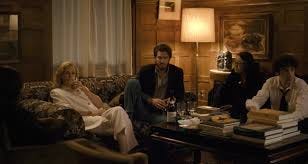
Set at Yale circa 2019, the film opens on a party being held at the home of one of the school’s top educators, famed philosophy professor Alma Imhoff (Julia Roberts), and her husband, Frederik (Michael Stuhlbarg). Among the guests are longtime friend Hank (Andrew Garfield), a department colleague who is brash, charming and a flirt with virtually every female he comes across, especially Alma, and Maggie (Ayo Edebiri), a Black lesbian grad student who is the adopted child of two of the school’s biggest donors and who has become Alma’s protege. Although Alma insists that Maggie is indeed a great student and a brilliant mind, Frederik, who is pointedly not an academic, isn’t so sure—he thinks that there is more of an erotic component to Maggie’s devotion to Alma and that Alma’s belief in her student’s intellectual qualities are inspired more by the younger woman’s flattery and devotion towards her (not to mention the immense amount of power, money and prestige she represents) and less by her actual work.
After an evening of chugging wine and engaging in long-winded protestations about the kids today and how their pronouns and identity issues are ruining academia and whatnot, the party (which seems to go on roughly as long as the wedding sequence in The Deer Hunter) finally winds down and everyone leaves with Hank walking Maggie back to her dorm room. The next day, after mysteriously skipping class, Maggie visits Alma and while she doesn’t flat-out say it, she strongly intimates that Hank sexually assaulted her after they got back to her room and she invited him in for a drink. Although Alma’s response to Maggie’s accusation may not be quite what one might expect from an avowed feminist, she confronts Hank, who not only proclaims his innocence but insists that Maggie has made up the entire thing because Hank had discovered that her dissertation was plagiarized. Caught between her prize student and her longtime colleague—with whom she is currently competing for a tenured position—Alma tries to figure out a way to stay as far out of the building controversy as she can but winds up getting ensnared as well as a number of her own issues, including a secret illness for which she has been secretly self-medicating and a scandal from her own past, end up threatening her own position as well.
Over the last few years, Luca Guadagnino has become one of the leading lights on the world film scene and for the life of me, I cannot quite understand why. The guy has an undeniable flair for visual style and has been known to get decent performances from his actors but his films, including I Am Love (2009), Call Me By Your Name (2017), Bones and All (2022), Queer and Challengers (both 2024), have always struck me as overheated exercises in operatic psycho-sexual nonsense that has never been quite as audacious or transgressive as he clearly seems to think that they are. Yes, he can certain come up with striking moments and images from time to time but if you force him to shoot a scene that involves nothing more than two people having a simple conversation in ordinary settings and he tends to be all thumbs. Perhaps not surprisingly, the only film of his that I have completely enjoyed was his remake of Dario Argento’s Suspiria, which was far better than it had to be, if only because it was based around a hallucinatory horror narrative that didn’t necessarily have to be lucid to succeed.
However, the central failing of After the Hunt is not his direction, though his self-consciously arty framing of certain scenes and the at-times overbearing soundtrack certainly don’t help. (The scenes in which Alma grills Hank for his side of the story and later advises Maggie on what to do are particularly egregious in these regards.) The problem is that the script by first-time screenwriter Nora Garrett is, to put it politely, garbage. It ostensibly tackles a number of controversial issues but as it goes on (and on), it becomes painfully apparent that it doesn’t really have much of interest or value to say about any of them and the few times that it musters up something resembling commentary (such as presenting the opening credits in the exact same style that Woody Allen employs in his films) are puerile at best. Structurally, it is a mess as well—the subplots involving Alma’s substance abuse issues and the dark secret that she is trying to hide are clumsily handled with the method in which the latter is introduced coming across as particularly inept—and is so resoundingly self-serious throughout that the whole thing takes on a stultifying air that makes it even more difficult to sit through with a straight face.
The characters themselves are just as bad and confused as everything else. To say that they are universally unlikable is not surprising, I suppose, but that isn’t the problem. A character can afford to be unlikable as long as the screenplay presents them in an interesting and compelling manner—see how Tar handled its controversial central character for an example of how to do this properly—and Garrettt and Guadagnino utterly fail in this regard. There is not a single character in this film who remotely resembles a plausible human being—they are nothing more than general caricatures meant to represent certain types in the broadest manner imaginable, which is somewhat amusing when you consider that a number of the characters themselves rail against such sweeping characterizations at frequent points. Perhaps the most insulting of the bunch is Maggie, who is less a person than a checklist of political correctness meant to serve as a punching bag for all the ills of contemporary society that is so contrived that she seems more like a refugee from a so-so SNL skit.
The best thing about After the Hunt is the performance by Julia Roberts as Alma. Like the rest of her cast mates (including a scandalously underused Chloe Sevigny), she is playing a character that is little more than an amalgamation of buzzwords and dated tropes. However, as she has shown in the past in films like Closer, she seems to relish the opportunity to play roles that allow her to show a colder, flintier side that stands in marked contrasts to her still-lingering America’s Sweetheart persona. Making effective use of her iconic presence, she gives us a character who has become so casually intimidating to everyone in her presence that she fails to recognize that she is quickly becoming her own worst enemy. However, not even she can quite overcome the screenplay’s awkwardness as it goes on and towards the end, she seems just as lost and unsure as the audience.
After the Hunt is a bad movie, to be sure, but it is also a frustrating one because it seems to have all the ingredients one would need to make for a compelling and topical drama. The idea of telling a story about the weaponization of cancel culture in the wake of things like the #MeToo movement is promising, the assembled cast is impeccable and it even has a director who clearly has the talent and skill to make a fine film (even if he has only rarely done it in the past). And yet, despite these ingredients, the film just doesn’t work because they are all in the service of a screenplay that is less an audacious provocation about the ills of contemporary society and more like an unhinged and generally insufferable rant delivered by someone who is so convinced of their attempts at bold truth-telling that they fail to realize that they don’t really have anything of interest to say. It is ironic that the film is set amidst the classrooms and offices of one of the world’s most prestigious universities since the screenplay would barely pass muster in an Intro writing class at most community colleges.