

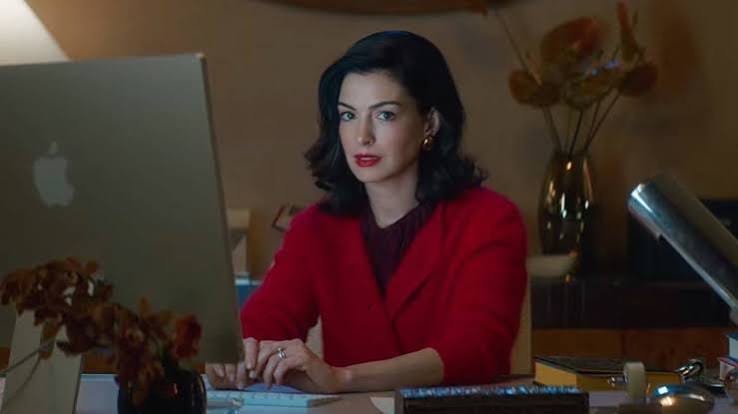
During what proves to be a key sequence amidst the madness that is Verity, a television set in the background is playing a clip from Brian De Palma’s 1980 masterpiece Dressed to Kill. This is entirely appropriate because it is clear that this film is trying to follow in its footsteps as a knowingly lurid erotic thriller. The hitch is that instead of emulating De Palma’s slickly hypnotic and teasingly sexy visual style, which pretty much hit its apotheosis with that film, this one appears to have taken its inspiration from the admittedly shaky narrative that De Palma jerry-rigged together to connect his big set pieces. Here is a story that is so palpably ridiculous on so many levels that, were it not for my sense of professional obligation, I might have considered just submitting the clip from Ghostbusters where Bill Murray says “This is preposterous. I demand an explanation” as my review as that would have more-than-adequately covered the waterfront. Put it this way—as films released this year featuring Anne Hathaway as a writer chafing at the constraints of marriage and familial obligations go, this one is slightly less plausible than The End of Oak Street.
But before we get to he, the film first introduces us to its other two key characters in one of the stranger Meet-Cute situations of recent memory. The wonderfully-named Lowen Ashleigh (Dakota Johnson) is a young writer of some acclaim but minuscule sales who is summoned by her agent (Ismael Cruz Cordova) to a top-secret meeting with a publisher. Just before she gets to the meeting though, she get a Raimi-sized splash of gore on her face and clothes courtesy of a bicyclist being hit by a car on the street corner where she is standing. She is rescued from this by Jeremy Crawford (Josh Hartnett), who leads her to a nearby coffee shop to clean up, gallantly offers her the shirt off his back and explains his borderline-unnerving calm by remarking “I’ve seen worse. I pulled my eight-year-old girl’s body out of a lake.” If that isn’t weird enough, when Lowen finally arrives at the meeting, she is surprised to discover that among those there to meet with her is none other than a freshly shirted Jeremy.
Besides having a dead child and ready access to shirts at the drop of a cyclist, Jeremy is also the husband of Verity Crawford (Hathaway), the best-selling author whose series of lurid thrillers, based around the twisting of nine moral and ethical guidelines in what I can only assume is something that suggest Krzysztof Kieslowki’s landmark The Dekalog as written by V.C. Andrews. (V.C., Verity Crawford—I might actually be on to something here other than a pretentious and poorly-landing joke reference)—have made her a global phenomenon. (Cue clips of Verity being grilled by Gayle King and chowing down wings on Hot Ones.) Alas, a year earlier, Verity was in a horrible car accident that has left her unable to work with three books left to complete. Having successfully kept news of the accident from getting out and not wanting to lose a cash cow, her publishers want a ghost writer to complete those last three books and Jeremy, based on Verity’s apparent admiration for her work, wants Lowen for the job, evenNo inviting her to stay with him, Verity and their young son, Crew (Brady Wagner)—the child who survived the tragic accident that killed his twin sister—at their house in Vermont so that she can go through Verity’s voluminous notes in order to prep the books. If all this strikes you as being just a bit hard to believe, you better bail out now because all of this proves to be staid and sensible compared to what is coming.
Lowen accepts and soon gets her first look at the house, a place so spectacularly over-the-top that I would dearly love to see its Zillow listing. This a place that has all the conveniences for a movie thriller aimed primarily at the female audience—high ceilings, fireplaces, walk-in closets, more hallways than the Overlook Hotel, a kitchen straight out of a Nora Ephron film and even a convenient masturbation bathtub that will eventually get some use at a key point (the same one involving the aforementioned Dressed to Kill clip, no less). The place also has a haunted vibe straight out of a Daphne Du Maurier novel that begins with its omnipresent view of that cursed lake and is further accentuated when Lowen finally meets Verity and discovers that her condition is far worse than she has been led to believe—the accident has left her totally catatonic, bereft of all but the most basic of motor skills and requiring the aid of a ominous caretaker nurse, the inevitably ominous Anna (Irina Dvorovenko).
Lowen gets to work and while going through all the paperwork, she stumbles upon a thumb drive that appears to contain a memoir written by Verity herself chronicling her life and, suffice it to say, the version that she presents there is slightly darker than the one trotted out on Call Me Daddy. In scenes narrated by Verity herself, we see how she first met Jeremy (a slightly less messy affair than his initial encounter with Lowen) and became instantly infatuated with him, how she became a writer to fill the time when he was away on business and her apparently undiagnosed postpartum depression following the birth of the twins led to a cooling of the marriage that she will apparently go to any means necessary in order to reignite. Many of these revelations disturb Lowen, not to mention her growing vague sense that perhaps Verity is not quite the helpless invalid that she appears to be. Is this just a psychological manifestation of the guilt Lowen feels in regards to the initially low-key flirtation between her and Jeremy or is it something more?
Verity is based on a novel by Colleen Hoover, the author of several best-selling books that I have not read, a number of which have gone on to be adapted into films that I have also managed to avoid, such as Regretting You, Reminders of Him and, of course, It Ends With Us, the film that launched a thousand lawsuits. I can’t say for certain whether Nick Antosca’s screenplay represents an accurate adaptation of her work (though research suggests that, save for a couple of understandable changes, the narratives are mostly the same) but if it is, then I don’t feel as if I have been missing much. The story is, as I have suggested, absolutely ridiculous, a feeling that is only accentuated by how seriously the film takes itself, and even the more allegedly jaw-dropping revelations regarding Verity and the lengths that she will go to in order regain the passion between her and Jeremy will seem somewhat old hat to anyone who has ever watched Leave Her to Heaven, the 1945 noir classic featuring Gene Tierney as a woman so cold-blooded that she would have derided the most lurid happenings in Verity’s books as kid stuff. As a suspense thriller, which the film ostensibly presents itself as, it doesn’t quite work because even if you are willing to forgive the barminess of the story as a whole, there is the fact that the suspense aspect doesn’t really kick in for more than an hour and even then struggles to get out of first gear to move into the kind of cheerfully overheated spectacle that the recent The Housemaid managed to become despite, or possibly because of, being just as conceptually insane as this one is.
I think that the key difference between those two films is that The Housemaid had, in Paul Feig, a director who was willing to not only embrace all the loopy elements that he was presented—dueling divas, steamy affairs, house porn, secret pasts and lurid plot twists that might not exactly hold up under even the most cursory of post-viewing examinations—but had fun with them by presenting them in a manner that took things at least reasonably seriously on the surface but delivered them with a wink that suggested that he knew just how preposterous the whole enterprise actually was. (This was the same approach that he utilized with the great A Simple Favor, a movie which could be seen as the Citizen Kane, or at least the Beyond the Valley of the Dolls, of this particular subgenre.) The main problem with Verity is that director Michael Showalter—whose career has seen him going from co-writing the classic Wet Hot American Summer to directing things like The Big Sick and the recent Hathaway-starring rom-com The Idea of You—never seems to have any real feel for the erotic thriller genre or willingness to dive headlong into its more hyperbolic elements. Instead of having fun with it, Showalter approaches the material in a plodding manner that ends up muting things to an almost unforgivable degree—few things are more awkward to witness than borderline campy melodrama played at the wrong speed—and leaves an ending that is clearly trying to be enigmatic to come off more like a shrug than anything else. If he fumbles in presenting the thriller aspect of the narrative equation, he is all thumbs when it comes to the erotic content—despite having three uncommonly attractive and charismatic leads, all of whom come into contact with each other at one point or another, the screen doesn’t so much steam as it does parboil since none of their assignations, as presented, manage to generate much in the way of real heat.
And yet, even though Verity is a very bad and very dumb movie, it is one that is at least sort of watchable, at least for a while, and that is due entirely to those three leads, though I cannot imagine that this will feature very heavily in any future Lifetime Achievement Award highlight reels that they might receive. Of the three, Johnson probably acquits herself best as the largely passive and dryly ironic attitude that she has brought to many of her films—not to mention the often-hilarious press tours following those films—is definitely on display here and indeed, some of the best moments are one in which she delivers certain lines in a manner that barely contains her apparent realization of just how ridiculous they are. By comparison, Hathaway has less to do (or does she) but there is fun to be had in the overtly plummy voice that she utilizes for Verity—that said, of all the numerous movies that she has appeared in over the course of this year to date, her turn here perhaps the least interesting of any that don’t have the word Prada in the title. As for Hartnett, he clearly realizes that he is playing the leg of the big character triangle that no one really cares about—if this were Casablanca (and it isn’t, I hasten to add), he would be Paul Henreid—and while his character is scarcely believable, he mostly manages to keep him grounded for the most part, at least in the scenes in which he isn’t fooling around with either one of his co-stars, of which there are enough to suggest that his agent deserves a big bonus this Christmas.
For the most part, however, Verity is a seriously dopey movie that is never quite as fun or trashy as it promises to be—it is dramatically inert, visually dull (despite getting a full theatrical run, it has the flat look of something made to be seen on a television screen), contains way too many loose ends for its own good (without giving anything away, I will merely say that I have certain questions regarding the nurse character and how she fits into everything) and doesn’t offer viewers anything, either in terms of the narrative or what one might refer to as the Good Parts, that they couldn’t get from the kind of mid-tier DTV items cranked out by the likes of Tanya Roberts or Shannon Whirry back in the day. I confess that in the end, I was kind of bummed because while it has a potentially interesting premise and a trio of hugely appealing stars, it has no idea of how make any real use of them. While it might appeal to fans of the book, newcomers to the story may find themselves wondering what all of the fuss is about. As for fans of Hathaway, Johnson and Hartnett, the idea of seeing them in the same film is not without its appeal but even that aspect never quite catches fire in the way that you think that it would. Oh well, maybe people who watch this will find themselves inspired by the presence of the clip from Dressed to Kill to check out the entire thing and get a look at the kind of pleasures a film of this sort can provide in the hands of the right people.