
Ghoul, So Confusing
My thoughts on Dracula

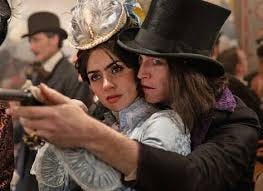
For over a century now, there has been a steady flow of films that have either been directly adapted from or “inspired” by Bram Stoker’s classic vampire tale Dracula and it doesn’t appear as if the deluge will be subsiding anytime soon. In just the last couple of years, we have seen takes as varied as the creepy The Last Voyage of the Demeter, the botched Nicolas Cage riff Renfield (2023), Robert Eggers’s grimly fascinating 2024 remake of F.W. Murnau’s silent classic Nosferatu and Radu Jude’s sprawling satirical epic Dracula (2025), in which he used the famous narrative as a way of offer scathing critiques of practically anything that may have come to mind while shooting. With such a current glut of product surrounding this particular property, anyone endeavoring to do yet another version of it at this particular moment should at least have some kind of approach to the material that is unique enough to differentiate itself from the countless other takes. The problem with the latest Dracula, which finds French filmmaker Luc Besson—the man behind such eye-popping favorites as Leon, The Fifth Element and the underrated Valerian and the City of a Thousand Planets—taking a crack at the story, is that while it does have elements of interest—and is certainly better than the undeniably terrible trailer might otherwise indicate—it never quite finds the kind of unique viewpoint that might have made into more than just a standard riff on material that is all too familiar at this point.
The story kicks off with a prologue set in the 15th century depicting Prince Vladimir of Wallachian (Caleb Landry Jones) going into battle against the Ottomans, only to lose his beloved wife Elisabeta (Zoe Bleu) along the way in a manner that inspires him to renounce God and embrace the vampire lifestyle as Dracula. The film then jumps ahead 400 years, relocating the narrative from the traditional London to late-19th century Paris, with the arrival at a local asylum of a mysterious man known only as Priest (Christoph Waltz) who appears to be a representative of a secret order of the Catholic Church who is interested in the the inexplicable case of a patient named Maria (Matilda De Angelis). Spoiler Alert—it turns out that she is a vampire, one of many that Van Hel—sorry, Priest, has come into contact with over the years in the hopes of finding the one responsible for turning them into bloodsuckers and destroying them once and for all.
Meanwhile, one Jonathan Harker (Ewens Abid) is off to Transylvania to do business with a mysterious new client who just happens to be Dracula himself. Things go sideways and Dracula, with the aid of his gaggle of live-in gargoyles (instead of the traditional vampire brides, which seems like a curious switch, particularly in a film directed by Besson), is about to start snacking on his guest when he gets a look at a photo of his fiancée, Mina (Bleu again), and is stunned to discover that she is the spitting image of his lost love. Leaving Harker alive but imprisoned in his castle, Dracula sets off for Paris to seek his beloved. Luckily for him, Maria, while under his spell, has managed to befriend Mina and brings the two together. At first, Mina gently rebuffs Dracula’s advances but she eventually finds herself swooning over this new suitor even as she frets about her long-absent fiancé, leading to the inevitable climactic moment where Dracula and Priest finally cross paths with the fate of Mina’s soul at sake.
As connoisseurs of vampire cinema can probably surmise, especially if they saw the aforementioned trailer, Besson’s take on Dracula owes a lot to Bram Stoker’s Dracula, Francis Ford Coppola’s go-for-baroque 1992 version, particularly in its emphasis on the era-spanning romance between Dracula and Elisabeta/Mina. The problem here is that, for reasons I will get into in a moment, the story has been contrived in such a manner that Dracula doesn’t actually end up meeting his lost love again until the film is more than half over, which doesn’t really leave much time to convincingly establish their relationship in a way that would allow the finale to have the kind of tragic resonance that it is clearly aiming to achieve. Jones (who starred in Besson’s previous film, the bizarre action-drama DogMan) and Bleu (who looks so much like her mother, actress Rosanna Arquette—who co-starred in Besson’s The Big Blue—that it is almost distracting at times) do what they can and they are certainly attractive enough but the script doesn’t really allow them to do much more than go through the motions.
The closest thing that Besson brings to the proceedings in terms of innovation is a lengthy section in which Dracula recounts to the imprisoned Harker about what exactly he has been up to over the last 400 years—making his way through European high society in search of the reborn Elisabeta, even going so far as to develop a perfume with a scent so intoxicating that any woman who encounters it will be immediately drawn to him. For the most part, this section does not work—partly because it goes on for way too long and partly because it needlessly removes one of the more potent aspects of Stoker’s original story (the way in which an aging aristocrat was literally feeding off of the lives of the easily missed downtrodden in order to unnaturally extend his own existence) with an addition that makes no logical sense, even by vampire movie standards, and which at times comes dangerously close to coming off as a ripoff of the stylish scent-based serial killer thriller Perfume: The Story of a Murderer. That said, while this sequence ultimately fails, it does supply a couple of amusingly over-the-top moments—particularly a dance montage involving hordes of entranced noblewomen moving in sync—of the sort that Besson relishes, even if they don’t necessarily fit in with everything else.
And yet, while it is neither a particularly good vampire film or a particularly good Besson film, this take on Dracula does have a few things going in its favor. Intriguingly, the cinematography and elaborate production design largely eschew the traditional Gothic trappings for a more painterly approach that gives it a look that is both striking and different from the expected dark shadows, spiderwebs and the like. Although it doesn’t quite approximate the driving music that Wojciech Kildar composed for Bram Stoker’s Dracula, Danny Elfman’s score is undeniably effective and one of his better recent efforts. And while Christoph Waltz’s performance as not-Van Helsing is unlikely to earn him a third Oscar, he is clearly having a lot of fun here as he goes about methodically chomping away at every available piece of scenery. Although the film never quite manages to make a convincing case for its own existence (especially to those who already have little fondness for Besson in general), these elements help it come across as at least slightly more watchable than one might have expected.
Solid breakdown of why this falls short. The perfume subplot replacing Dracula feeding on the downtrodden is a weird choice that undercuts what makes the story work thematically. I watched alot of Besson's earlier work and he's had this thing where he throws in elaborate sequences that dont quite fit. The painterly aesthetic sounds intresting tho, might be worth checking out for the visuals even if the romance timeline doens't land.