
Love, Bytes
My thoughts on Tron: Ares and the return of The Lovers on the Bridge

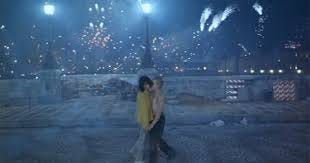
By the time that Les Amants du Pont-Neuf, a.k.a. The Lovers on the Bridge, the third film from director Leos Carax arrived in French cinemas in 1991, it was already somewhat of a legend due to its astronomical budget, which included the construction of a replica of Paris’s Pont-Neuf bridge when shooting on the real thing became too complicated, a protracted and lengthy production period, and the relationship between Carax and co-star Juliette Binoche, who began the project as lovers but who broke up before its conclusion. When it was finally shown to the public, it divided viewers between those who felt that the story—which chronicles the romance that develops between a vagrant circus performer (Denis Levant) and an artist (Binoche) suffering from a disease that is gradually turning her blind—was too thin, hokey and melodramatic to warrant such an opulent production and those who were blown away by the glorious visual spectacle on display in virtually every frame. Because it was so expensive, it needed to be a success in the international market but after a pan from The New York Times when it played the 1992 New York Film Festival, no distributor would touch it, especially not for the price the producers were demanding. Finally, in 1999, Martin Scorsese prodded Miramax into releasing it in the U.S. but, as tended to be the case with a lot of the films that they picked up during that time that they weren’t blatantly pushing for awards, it wound up falling through the cracks. Since then, it has been released on DVD and Blu-Ray but that has only been small consolation since this is the kind of film that absolutely needs to be seen on the big screen.
Now The Lovers on the Bridge is returning to theaters in a new 4K restoration from Janus Films (suggesting that a Criterion 4K edition is forthcoming) and if you are anywhere near a venue that is showing it and profess a true love for cinema, you owe it to yourself to do whatever you can to catch it in the manner in which it was meant to be seen. I am pretty much a fan of all of Carax’s films—including such visionary works as Mauvais Sang, Pola X, Holy Motors and Annette—but this one leaves even those esteemed works in the dust, The basic storyline is undeniably melodramatic and perhaps even old-fashioned but Carax presents it in a disarmingly earnest manner that makes it work, aided in no small part by the obvious chemistry between Levant (a regular fixture in Carax’s oeuvre) and Binoche (whose relationship with Carax may have been rocky but who has never looked lovelier than she does here). As for the production, it is undeniably overblown but it is overblown with a purpose as Carax uses the millions at his disposal to bring his crackpot notions to life and creating some of the most unforgettable cinematic visions I have ever seen in my life along the way—the extended sequence in which the two lovers dance upon the bridge and eventually go water-skiing on the Seine while the sights and sounds of the Bastille Day celebration fill the skyline behind them is so glorious that when it comes to its conclusion, you want to applaud it as you might a show-stopping number in a musical. As crazy-pants, eye-popping and swoon-worthy as it was when it first came out, The Lovers on the Bridge is a work of such grand beauty and ambition that I find myself actually pitying those who have never quite found themselves sharing its wavelength. At a time when most movies, even the lavish blockbuster spectacles, tend to be formless and forgettable, here is one that I can pretty much guarantee that you will never forget

.By sheer coincidence, I wrote that last sentence before venturing out to see Tron: Ares but I cannot think of a better way of describing this example of this aggravatingly pointless example of IP idiocy. Monstrous tech bro Julian Dillinger (Evan Peters, the grandson of the human bad guy from the original Tron, has devised a plan to create digital super-soldiers and weaponry that can be used in real life that will make untold billions for the company bearing his family name. The only hitch is that as of now, these creations can only last for 29 minutes in the real world before crumbling into dust. As it happens, Eve Kim (Greta Lee), the current CEO of Encom, the tech company led by ace programmer Kevin Flynn before his mysterious disappearance decades earlier, has managed to find this so-called “permanence code” among a bunch of Flynn’s old floppy discs. When Julian get wind of this, he sends his most powerful super-solider, Ares (Jared Leto), to track her down and take the code from her, even if it means zapping her into the virtual world. However, Ares—spoiler alert—has found himself growing more intrigued by us humans and such things as our feelings and our Depeche Mode and he winds up helping her escape back into the real world, where Dillinger’s digital soldiers follow in a destructive pursuit through San Francisco that is probably not going to look too good in the company’s next quarterly report.
I remain a huge fan of the original 1982 film Tron—while the story was undeniably uneven, the bold visual style that utilized then-emerging CGI technology to imagine the world inside of our computers was absolutely mesmerizing to watch (and the tie-in coin-op video game was an all-timer to boot)—and I didn’t mind 2010’s legacy sequel Tron: Legacy, though I admit to barely remembering anything about it now other than the fact that it exists. Despite my general fondness for the franchise up till now, even I recognize the absolute hollowness of this stab at brand extension. The story is little more than overblown fan fiction that is way too convoluted for its own good without ever becoming interesting and it has been staged with terminal listlessness by director Joachim Ronning, Disney apparent in-house go-to guy for sequels that have no real reason for being (including Pirates of the Caribbean: Dead Men Tell No Tales and Maleficent: Mistress of Evil, two films that I can almost guarantee you forgot existed until reading this parenthetical aside). The film also has a weird pro-AI slant to it that feels like exactly the kind you would expect to come from a corporation entity and which is particularly jarring to endure.
Most of the cast—which also includes Gillian Anderson as the tech dude’s disapproving mother, Jodie Turner-Smith and Ares’s second-in-command and Jeff Bridges in a brief, presumably contractually-required turn—is wasted in roles that require them to stand around and react to things that aren’t there while reciting lines that are almost literally unspeakable. (As happy as I am to see Greta Lee getting a presumably big payday, it is a bummer watching her struggle to connect with the material throughout.) As for Leto, while his casting makes a little bit of sense—he is pretty much the embodiment of what a d-bag like Dillinger might consider to be edgelord material—his performance is so vapid and devoid of charisma that watching him as he struggles to show glimpses of humanity is at times painful to watch. (I’ve seen Bruce Boxleitner and believe me, he is no Bruce Boxlietner.) To be fair, there are a couple of interesting visuals here and there (if you must see it, try to do so in a theater showing it in IMAX 3D) as well as a pretty nifty score from Nine Inch Nails but for the most part, Tron: Ares is a waste of time that, despite the implication of the inevitable post-credit sequence, should signal GAME OVER for the franchise at last.