
Memories
My thoughts on The Dreadful, EPiC: Elvis Presley in Concert, How to Make a Killing and This is Not a Test


Set in 15th-century England, the folk horror saga The Dreadful stars Sophie Turner as Anne, a young woman living in a remote seaside area with her mother-in-law, Morwen (Marcia Gay Harden) while awaiting the return of her husband (and Morwen’s son), Seamus, from fighting in the War of the Roses. Theirs is a harsh existence but Morwen in particular is determined that they will indeed see Seamus again and takes to increasingly brutal methods to help ensure their survival. Soon, they are visited by Jago (Kit Harrington), an old friend of both Seamus and Anne who went off to fight alongside Seamus and who has returned with terrible news about his fate. Before long, it becomes apparent that Jago’s childhood crush on Anne has not abated at all and while she is still grieving the loss of her husband, Anne cannot deny that she has feelings for him as well. Although she would like to go off and marry Jago and live with him, she is terrified of what the increasingly dangerous Morwen might do if she tries to break off their increasingly co-dependent relationship. And if that wasn’t enough angst to go around, there also appears to be a mysterious amor-clad knight lurking about who might just be some kind of hallucination but which might also hold the answers as to what really did or did not happen to Seamus back on the battlefield.
If this description sounds vaguely familiar, it may be because it is a sort-of remake of Kaneto Shindo’s 1964 Japanese horror classic Onibaba, although it doesn’t exactly go out of its way to announce itself as one. As largely unnecessary remakes of stone-cold classics go, this one does have a few things going for it. The look of the film that writer-director Natasha. Kermani establishes early on, at once alluring and foreboding, is reasonably effective, as is the relationship that develop between Anne and Jago. Yes, the latter does develop into a romance and yes, seeing Harrington and Turner, who played siblings on Game of Thrones, does add a certain creepy factor to their potential coupling that actually works to the narratives benefit. The problem is that the screenplay never quite makes the tensions between the emerging triangle into anything credible or interesting, particularly failing to make the film’s key relationship, the suddenly fluctuating one between Anne and Morwen. Although Turner is just fine as Anne, she never seems convincing cowed by Harden in their early scenes to make her transformation really ring true, particularly towards the misfired revised ending that Kermani has given us here. The biggest problem, of course, is that even at its best, it never comes close to evoking the eerie power that Onibaba continues to hold over viewers to this day. The Dreadful isn’t terrible, I suppose, and those who come into it without any working knowledge of its predecessor might get a little more out of it than those who do. That said, considering the fact that Onibaba is not that hard to come across these days, I can’t see any reason to bother with this retread when you could just stick with the original
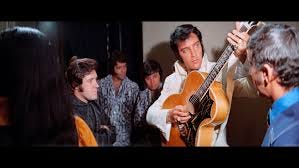
.Although the title would suggest otherwise, EPiC: Elvis Presley in Concert is not strictly a straightforward concert film by any means. For his second cinematic take on the King, following his appallingly dunderheaded Elvis, Baz Luhrmann has combined familiar archival material with recently unearthed footage shot during his initial residency in Las Vegas following his return to live performances in 1969 into a hybrid of the two in which the commentary is supplied entirely by Presley himself in the form of press conference interrogations, behind-the-scenes footage and, of course, through his renditions of some of the most famous songs of the 20th century. Although the end result is infinitely better than Elvis—indeed, 2 1/2 hours of blank leader would have been an improvement—this film is still a disappointment in some respects, most of them revolving around the documentary aspect. Presumably as a way of getting the all-important approval of the Presley estate, as was the case with the earlier film, the Elvis depicted here is practically a saint without any of the issues that he clearly had even back then and anything even remotely troubling—such as his refusal to speak out publicly on issues regarding civil rights to the Vietnam war to his never touring outside of the U.S.—is implicitly pinned entirely on Colonel Tom Parker, who is often seen lurking in the background and whose first appearance is scored to “You’re the Devil in Disguise.” Likewise, his troubled relationship with wife Priscilla is giving such short shrift here that she is only seen briefly in a maudlin montage scored to “Always on My Mind” more than an hour into the proceedings. (Perhaps this is revenge for the existence of Sofa Coppola’s Priscilla, which came out the same year as Elvis and painted their relationship and his character in a much harsher light.)
And yet, while EPiC doesn’t exactly work as a documentary—for the most part, it is little more than a shorter version of This is Elvis without all of the dark and heartbreaking stuff that would come after the period covered here—it is far more impressive when it lets the musical aspects take center stage. Culled together from a number of performances, the film serves as a reminder—not that one was exactly needed—that Elvis, until the combination of drugs and lethargy finally overtook him, was a truly magnetic performer—a man who reveled in onstage bombast without ever letting it overwhelm him. Happily, Luhrmann recognizes that and pretty much refrains from deploying his usual array of flashy cinematic tricks (he largely limits these to the rapid-fire opening scenes offering a crash course in all things Presley leading up to the performances) so that viewers can simply bask in the spectacle of watching him effortlessly work the room while belting out impassioned versions of everything from “Tiger Man” to “Suspicious Minds” to grand effect—grander still if you are able to catch the film in the large-screen IMAX format. While it doesn’t quite absolve Luhrmann of the cinematic sins committed in Elvis and probably should have just jettisoned the unenlightening documentary stuff to make it a full concert experience, EPiC is a slick, well-engineered celebration of Presley the performer that will clearly satisfy his devoted fans and perhaps even inspire some new ones as well.

As How to Make a Killing opens, one Becket Redfellow (Glenn Powell) is sitting on Death Row and decides to kill what may be the last few hours of his life explaining to a visiting priest how he wound up there. We learn that he was the son of a woman who grew up amidst incredible wealth until she was cast out of the family by her imperious father (Ed Harris) when she became pregnant at the age of 18. Although the two end up living in greatly reduced circumstances—they end up living in New Jersey where she works for the DMV—she instills in him both a taste for the finer things in life and the information that, due to a quirk in the family trust, he can still take control of the massive family fortune, provided that the seven people above him on the family tree all die beforehand. Driven with the twin desires to become rich and to avenge the wrongs against his deceased mother, Becket begins bumping them off one by one utilizing fairly creative methods, none of which I will reveal here. Before long, he starts getting pretty good at it but along the way, he gets distracted by his unexpected relationships with one of his future targets, an uncle (Bill Camp) who regrets how Becket was treated and gives him a job at one of the family companies that allows him to prosper on his own and Ruth (Jessica Henwick), who was the girlfriend of one of his early victims and who doesn’t have much interest in outrageous wealth. For a brief period, it seems as if Becket might stop his killing spree and be content with what he has accomplished, but that changes with the return of Julia (Margaret Qualley), the rich girl who was his childhood love. After they cross paths again, she immediately figures out what he is up to and more or less compels him to keep going with the plan.
Luckily for Becket, he doesn’t preface his tale with “Stop me if you’ve heard this one before” because the priest might indeed say yes for the film is essentially a remake of the Ealing Studios 1949 film Kind Hearts and Coronets, the British comedy classic in which ostensible gentleman Dennis Price decides to hasten the arrival of his inheritance by killing off the relatives (all of whom were played by Alec Guinness in what would be the first tour-de-force performance of his career) standing in his way. The film doesn’t seem too eager to promote its provenance, citing it only at the very conclusion of the end credits, but considering how much it ends up fumbling the material, it could be argued that it is really doing the original a favor. Granted, remaking a legendary comedy is almost always a dicey proposition but writer/director John Patton Ford (whose previous film, Emily the Criminal, also told the story of someone going to extraordinary and legally dubious lengths to make a quick buck) fails to supply any of the nervy energy or big laughs that you might expect, instead going for a largely goofy tone that tries to suggest the Coen Brothers more than Ealing but misses the mark on both counts. Instead of allowing us the pleasure of watching Becket develop and execute, so to speak, his increasingly elaborate methods of eliminating his competition for the family fortune, they all just sort of happen with the kind of grace and finesse one might expect in a lesser Pink Panther film.
While Powell once again demonstrates his effortless charm, the aura of affability that he maintains throughout doesn’t allow him to suggest either the quiet rage that presumably drives him through the early killings and the increasing sense of desperation—now that he actually has something to lose if he is caught—fueling the later ones, rendering the darker comedic points moot. The film also manages to waste a fairly strong supporting cast on roles that are too brief and thinly written to inspire much in the way of laughs—even the seemingly indefatigable Qualley, who has become one of the most reliable scene-stealers in recent memory, fails to bring much fire to her character or the movie as a whole with the material she is working with. How to Make a Killing isn’t so much a bad movie as it is a surprisingly dull and frustrating one. Here is a film that has so many potentially good elements at its disposal (game actors, a talented writer-director and a seemingly surefire premise) and fails to make real use of any of them—this proves to be a bigger crime than anything seen in the film itself
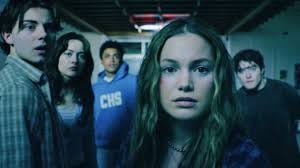
.Based on the young adult novel of the same name by Courtney Summers, This is Not a Test begins by giving us a brief but harrowing glimpse into the life of high school student Sloane (Olivia Holt), whose home life is such an unrelenting parade of horrors—her mom is dead, her father (Jeff Roop) is physically and verbally abusive and her beloved older sister (Joelle Farrow) has just taken off and left her behind—that the first time that we see her, she is preparing to commit suicide. Alas, the maxim about things getting better is not the case here because before she can do that, her small town is suddenly overrun by zombies—the 28 Days Later type that run fast and flail their arms in a rage while trying to bite anyone in their way. Escaping one attack, she runs into a few of her classmates—Cary (Corteon Moore), Rhys (Froy Gutierrez), Trace (Carson MacCormac) and Grace (Chloe Avakian)—and the five of them eventually hole up inside their now-abandoned high school. While waiting to hear of any word of possible rescue, the five settle in and while things are reasonably amicable at first—there is even time for a drinking game—the combination of teen angst, raging hormones and, oh yeah, the raging zombie apocalypse just outside, begin to make the situation inside almost as dangerous as the one outside. Tensions escalate even further with the unexpected arrival of a sixth person in the form of one of their teachers (Luke MacFarlane), who turns up with a shady story of how he arrived, a loathsome attitude and, perhaps inevitably, a gun.
Essentially, This is Not a Test is a film that asks the question “What might have happened if the kids from The Breakfast Club were forced to endure a zombie apocalypse during detention?,” and the answer, at least as presented by writer-director Adam MacDonald, is “Nothing much.” To give the film some credit, especially considering the project’s YA origins, the zombie action is surprisingly gory and brutal, even if the fast-moving undead conceit has now become as cliched as the slow shufflers of the sort favored by the films of the late George Romero. However, the focus is less on characters spewing blood and more on baring their souls and that is where the film steps wrong. While the attempt to juxtapose conventional screen horrors with the all-too-real grimness of adolescence sounds like an inspired idea, the film doesn’t really make much of it as it turns into a slog that is grim and humorless, even by zombie apocalypse standards. One big problem is that it so overburdens the Sloane character with so many traumas even before the overt carnage begins that it can barely be bothered to supply the others with more than one particular personality trait—Cary is the hothead would-be leader, Rhys is the nice guy with a not-so-secret crush on Sloane and Trace and Grace are twins. As a result, the scenes of them coming to terms with each other quickly grow tedious and aside from the fact that not everyone survives to the end, none of them really develop as characters during their time together, which grows monotonous after a while. Obviously, I cannot recommend This is Not a Test but if the idea of a bunch of kids stuck together inside of their school as flesh-eating ghouls run rampant just outside sounds interesting to you, allow me to point you instead in the direction of the infinitely more inspired 2017 British import Anna and the Apocalypse, a wildly ambitious and mostly wonderful film that took that same basic premise and was not only able to explore it with more wit, insight and gore than this film is able to muster but also managed to make it a musical to boot