
Nice Beavers
My thoughts on Dolly, Hoppers, Protector and Sirat


As Dolly, the grim and grisly new feature from director/co-writer Rod Blackhurst, begins, affable dope/single dad Chase (Seann William Scott) is taking his girlfriend, Macy (Fabianne Therese), for a hike deep into the woods so that he can propose to her. As anyone with even a rudimentary knowledge of the rules of horror cinema can attest, this is a spectacularly bad idea even before the two stumble upon a collection of creepy-looking dolls that have been arranged on the ground and in the trees in a strangely totemistic manner. Alas, before they can sensibly feel to safer ground, they are set upon by Dolly (played by wrestler Max the Impaler), a hulking brute wearing a doll-like mask who does something to Chase that is either horrible or hilarious (mostly depending on your personal feelings regarding Seann William Scott) before absconding the unconscious Macy to a bizarre house, where she wakes up to discover that she has been dressed like a child and is being forced to play the part of her captor’s young daughter in increasingly revolting ways. Even before the gore begins to flow—not that you will be waiting too long for that to occur—it is evident that Blackhurst is attempting to revive the grim and grisly feel of such grindhouse classics as the original versions of The Texas Chain Saw Massacre and The Hills Have Eyes, right down to showing in 16mm in order to evoke the grainy visual aesthetic of those films. While he manages to recreate that style of horror cinema on a surface level, it never digs deep enough to unnerve viewers in the ways that its predecessors were able to do. The storyline, what little there is of it, is painfully derivative, Dolly, for all his perversions and cruelties, is a lumbering but ultimately forgettable lunk, the hapless heroes are equally meh (though Therese works overtime to make something of her character and is easily the best thing here) and even at a brief 83 minutes, it wears out its welcome long before it ends. As a slot-filler in a horror-specific festival lineup, Dolly might be a passable view for less-discriminating genre buffs who just want to see some gross stuff but for everyone else, it is little more than a grisly and overly familiar stumble through familiar tropes that adds nothing of interest of its own
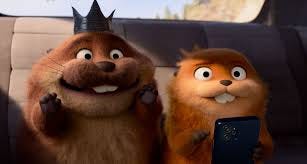
.Hoppers, the latest animated effort from Pixar, focuses on Mabel Tanaka (Piper Curda), a college-age woman with an intense passion for the environment that she learned from her beloved and recently deceased grandmother. When her town’s glad-handing mayor, Jerry (Jon Hamm), makes the destruction of her favorite glade in favor of a freeway overpass a central part of his current campaign, she leaps into action to try to figure out why the beavers have departed and to bring one back in order to revive the ecosystem and stop the road project. This eventually leads to the discovery that her environmental science professor, Dr. Sam (Kathy Najimy), has developed a technology that allows the human consciousness to enter a hi-tech robotic animal so that they can move amongst them unobserved. Mabel plants herself into a robot beaver and goes off to convince them to return, only to discover that all the animals are living together in relative harmony (and with a common language) under the benevolent rule of beaver King George (Bobby Moynihan), whose “Pond Rules” even extend to herbivores giving consent to being eaten by those higher than them on the food chain. Unfortunately for Mabel, her zeal for trying to inspire the animals to take back their land works too well and a number of them begin plotting a full-scale violent revolt against the humans with Jerry as their first target, forcing her, with the help of King George, to figure out a way of saving both her usual nemesis and the glade without violence or destruction.
In other words, Hoppers is essentially a bizarre hybrid of Avatar (which the film itself name-checks at one point) and Frogs, the immortal 1972 eco-horror epic in which the denizens of a Southern swamp rise up to kill the family of a pesticide-happy monster played by Ray Milland. On the surface, it sounds like a film in the classic Pixar mold of combining slick animation, goofball humor and moments of pathos with a gentle exploration of real-world issues and concerns and while it is certainly better than the studio’s decidedly uneven recent output (save for Turning Red and Inside Out 2), it doesn’t quite stick the landing, especially in comparison to what they were able to accomplish with astonishing regularity back in their golden age. The narrative concocted by screenwriter Jesse Andrews and director Daniel Chong does a decent job of setting up both Mabel’s budding activism and the conceit of an animal kingdom in which power is equally divided amongst different species and everyone exists in surprisingly harmony with each other. However, as it goes on, it begins losing its grasp in the second half, ignoring the questions that it raises about the efficacy of direct action vs quiet persuasion when facing forms of oppression (a conceit that could be seen as just a tad relevant these days) for a lackluster conclusion involving a villain everyone can despise and a message about compromise that comes off as somewhat mealy-mouthed amidst the usual hijinks and wackiness. That said, Hoppers is bright, fast-paced, colorful and amusing enough to entertain the little ones without completely putting older viewers off. It certainly isn’t bad by any stretch of the imagination but while watching it, I got the sense that maybe it could have used one last pass on the screenplay to help further develop the stuff that does work while disposing of the rest
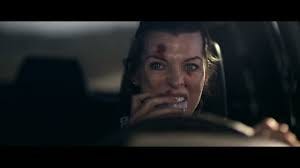
.Faithful readers will know that I have no small amount of fondness for actress Milla Jovovich and that perhaps I have gone through any number of critical contortions in order to justify projects of hers that I might have otherwise slammed if they had featured different actresses. I will neither accept nor deny those charge but even if that were true, I would still be unable to convincingly pull off such a thing in the service of her latest effort, Protector, a film that starts off as a silly action potboiler before taking a number of inexplicable twists and turns along the way. Jovovich plays Nikki, a recently widowed war hero who has missed out on most of the childhood of her 15-year-old daughter Chloe (Isabel Myers) and who has now become overprotective as a result. One night, on her birthday, Chloe sneaks out to celebrate with some friends at a bar and has her drink spiked by a couple of goons employed by human traffickers who take her away. Realizing that she has about 72 hours in which to find Chloe, Nikki sets out to rescue her and kill pretty much everyone who gets in her way, whether they are goons sent by the the head trafficker (Gabriel Sloyer) to a police captain (D.B. Sweeney) who seems unusually determined to take her down, despite the pleas of her superior officer, Colonel Joseph Lavelle (Matthew Modine), who wants to take her in peacefully. The rest of the film is essentially one extended slaughter fest in which Nikki shoots, stabs, strangles and otherwise decimates hordes of faceless goons before. . .well, I’d tell you, but you probably wouldn’t believe me.
In the early going, Protector is little more than a crummy and predictable ripoff of Taken with Jovovich doing Liam Neeson and director Adrian Grunberg once again exploiting the horrors of sex-trafficking for lurid B-movie thrills as he did in his previous project, the long-forgotten Rambo: Last Blood. As it goes on, however, it quickly devolves into a bizarrely structured and wildly disjointed mess (with one seemingly important action sequence only being described to us rather than shown) in which no one seems to act like a plausible person—even with the more elastic parameters of action film storytelling—while first-time screenwriter Bong-Serb Mun seems determined to cram in blatant references/thefts of far superior films, ranging from the obvious likes of the original First Blood and the John Wick franchise entire to outliers like the Michael Ritchie cult classic Prime Cut and another title that I cannot reveal without blowing the film’s surprise ending. That surprise ending, by the way, is particularly ridiculous—an out-of-nowhere twist that even M Night Shyamalan might have elected to rethink before including it. The fight scenes are certainly gory enough but none of them have any real impact and the decision to shoot many of them in Gordon Willis-like darkness (possibly to hide the faces of the stunt people) makes it a struggle to even see what is going on. Even taken simply as a excuse to watch Jovovich kick ass for 90 minutes, it comes up short—although convincing enough in regards to the physical aspects, she just seems oddly disconnected from the proceedings throughout and while that is partly explained during the screw-loose conclusion, it doesn’t help make Protector comes across as anything other than a bottom-of-the-barrel programmer that even action buffs will find wanting
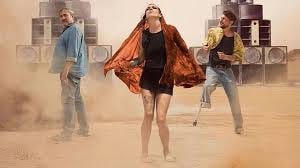
.Finally opening wide in order to capitalize on its Oscar nominations, where it is competing for the International Film and Sound prizes, Oliver Laxe’s thriller Sirat opens in what might be a post-WW III world to the throbbing beat of a rave being held in somewhere in the Moroccan desert, where thousands of young people are blissfully swaying to the music. Standing out amongst the crowd is the much older Luis (Sergi Lopez), who, along with his young son, Esteban (Bruno Nunez Arjona), is making his way through the crowd in search of his missing daughter, who he suspects may be one of the attendees. He has no luck finding her there but a group of young ravers—Jade (Jade Oukid), Josh (Joshua Liam Henderson), Stef (Stefania Gadda), Tonin (Tonin Janvier) and Bigui (Richard Bellamy)—inform him that there is an upcoming rave at a different locale that she might be at. When soldiers appear to break up the gathering, Luis and Esteban decide to following along, despite not have any of the gear or necessities one might need for journeying far into the desert. Although the ravers are not sure about having these newcomers along for the ride, they end up bonding with the interlopers as the journey takes a number of dark and surprising turns.
The result is an existential thriller that comes across like a bizarre amalgam of large chunks of the oeuvre of Michaelangelo Antonioni, William Friedkin’s Sorcerer and Gus Van Sant’s Gerry, albeit with a never-ending beat that you can dance to throughout and while it has received extravagant praise in some quarters, I am not so sure about all of that. From an aesthetic perspective, it undeniably works—the cinematography is striking throughout and while listening to EDM for nearly two solid hours is not exactly my idea of a thrill, the sound work is also quite impressive as it serves as both the the source of the liberation of the characters on display and the soundtrack as they journey further into what is essentially hell. Unfortunately, while the setup is intriguing, there is no real follow-through to anything—we never understand why the adult-age daughter left her family or why Luis is so hellbent on bringing her home—and while the disasters that occur along the way are undeniably startling when they first happen, they add nothing more than minor shock value. Sirat is not without its moments of glory and I am glad I saw it, I suppose, but in the end, it comes across in the matter of what I suspect most actual raves are like—it is fascinating for a little but after a while, all that you will want to do is just bail on it and go home.