
Rough And Twisted
My thoughts on Evil Dead Burn, Gail Daughtry and the Celebrity Sex Pass and Night Nurse


Following the death of her husband, William (George Pullar), in a violent car accident, his French widow Alice (Souheila Yacoub) turns up for his sparsely attended funeral before going off to spend time with his family—father Edgar (Errol Shand), mother Susan (Tandy Wright), brother Joseph (Hunter Doohan), his girlfriend Thya (Luciane Buchanan) and dementia-riddled grandmother Polly (Maude Davey)—at the remote run-down family home they own near the woods. Right from the start, things are more than a tad uncomfortable between them—William’s parents never particularly cared for Alice before and now essentially blame him for his death while Alice, who endured all sorts of physical and mental abuse at William’s hands, is not exactly in what might consider to be proper bereavement mode. Although it may sound like I am describing an especially grim Tracy Letts melodrama, this is, in fact, the basic setup for Evil Dead Burn, the latest installment in the spectacularly gruesome and surprisingly long-lasting horror franchise. As it happens, William’s family has some connection with the saga’s demonic creatures, popularly known as Deadites, and before too long, they each become infected with the malevolent spirits that cause them to try to rip each other apart, with all of them taking a special interest at varying point in doing particularly horrible things to interloper Alice. Over the course of one long night, Alice employs whatever means necessary (and luckily, the house is filled with more potentially harmful items than a Tex Avery cartoon) to chop, stab and sear her way through them in an increasingly desperate effort to save herself from a fate only slightly worse than dinner with a family that doesn’t particularly want you there in the first place.
Although I bow to no one in my love for the Evil Dead films directed by Sam Raimi, the brutal but wildly energetic 1982 original and the increasingly goofy splatstick horror-comedy hybrids Evil Dead II: Dead By Dawn (1987) and Army of Darkness (1993), I was not particularly impressed with the first two attempts to reboot the franchise long after Raimi himself set out for greener (or greener-screened) pastures with his various superhero ventures—both the 2013 revision from Fede Alvarez and Evil Dead Rise, the 2023 effort directed by Lee (Lee Cronin’s the Mummy) Cronin, spent way too much time and effort trying to outdo the sheer brutality of the original without coming close to approaching the style and wit that kept them from being more than forgettable exercises in mindless gore. That unfortunately proves to be the downfall of this entry as well—while the film is certainly gory enough throughout to once again demonstrate that the MPAA rating system is nothing but a joke, that is ultimately all that it really has going for it in the end. None of the characters are particularly interesting or likable—even ostensible heroine Alice is a bit of a pill at times—and as a result, there is no real sense of drama or horror to be had once they start trying to tear each other apart.
Although made with a little more visual style than the last two entries, none of the elaborate camera moves or CGI contrivances on display throughout come close to approaching the still-memorable marvels that Raimi and Co were able to accomplish for so much less back in the day. And while I suppose I am happy that this is a horror film that could not be less liminal in its approach if it tried, it instead marks a return to the whole “Elevated Horror” concept as the entire narrative becomes yet another leaden metaphor from processing trauma that plays like reheated Ari Aster and which is not nearly as profound as it seems to think it is, especially when it all clocks in at a vastly overextended 110 minutes. If all you want from a film like this is a never-ending orgy of spewing blood and flying limbs, then Evil Dead Burn should at least temporarily satisfy those needs (though I hasten to add that the only moment that actually has a genuinely stomach-churning impact contains neither of those elements). However, if you are one of those who, despite recent missteps, have continued to hold the Evil Dead franchise in high regard on the basis of its past glories, you may find yourself thinking that it is way overdue for a burial of its own

.The celebrity sex pass, for those unfamiliar with the term, is a thing in which each member of a couple picks a celebrity that, should the occasion arise, they would have permission from the other to have sex with if the occasion should arise. It is a dumb concept—the kind of thing that does nothing but inspire arguments between people who have nothing better to talk about—but it proves to be the starting point for the odd new comedy Gail Daughtry and the Celebrity Sex Pass. Gail (Zoey Deutch) is a small-town hairdresser who is getting ready to marry her childhood sweetheart in a couple of weeks when she catches her fiancé in flagrante delicto with his celebrity of choice (whose identity I will not reveal, though many others already have done so). Crushed, she heads off with best friend Otto (Miles Gutierrez-Riley) to Los Angeles for a hairdressers convention when a visit to a psychic convinces the now-troubled Gail that the only way to even the scales and make things between her and her betrothed is to seek out and bed her stated celebrity, Jon Hamm. Already in his neck of the woods, the two set off to make Gail’s dream come true and pick up a motley crew who have their own reasons for seeking out Hamm as well—a failed would-be agent (Ben Wang), a down-on-his-luck paparazzo (Ken Marino) who considers the actor to be his white whale and, perhaps inevitably, John Slattery (John Slattery). As the gang journey through the streets of L.A., they don’t realize that they are in the crosshairs of Ludovica (Sabrina Impacciatore), who discovers that Gail is in inadvertent possession of a briefcase containing top secret, world-changing information and sends her minions out to stop her and get it back at all costs.
This is, of course, a profoundly silly premise for a film—one that gets even sillier when you realize that the entire narrative, as you might be able to glean from the above description, is essentially a bizarre riff on the immortal The Wizard of Oz—and one so absurd that it seems tailor-made for the talents of director/co-writer David Wain, whose previous efforts include the cult classic summer camp movie satire Wet Hot American Summer and the should-be-a-cult-classic rom-com spoof They Came Together. And yet, the combination of cleverness and sheer goofiness that fueled those earlier films never quite comes together here. While those movies had great fun in skewering the tropes of their respective genres in dizzyingly surreal and frequently hilarious ways, this one, which Wain co-wrote with Marino, doesn’t really seem to have anything driving it beyond some mild jabs at Hollywood and the whole Wizard of Oz conceit, which they proceed to make more glaringly obvious as it goes on in order to ensure that everyone in the audience gets it. The results are, to put it mildly, uneven—the hit-to-miss ration for the jokes is practically the inverse of something like Wet Hot American Summer—but while there were long stretches where I failed to even crack a smile, there were also moments here and there where I was indeed laughing out loud—the book reading being done by the fiancée’s celebrity-of-choice that brings them into his orbit in the first place, Slattery getting his foot slammed into a door repeatedly and a bizarre riff on Elizabeth Perkins among them—and while Deutch has often inspired a reaction from me akin to hearing fingernails on a chalkboard, she is amusing and appealing here as she, like her fellow actors, clearly commits to the silliness on display. I can’t fully recommend Gail Daughtry and the Celebrity Sex Pass—even at its best, it too often has the rushed feel of a bunch of friends fucking around on something that even they know is too silly expend any real effort on—but it does contain enough solid laughs to make it worthy of consideration to fans of Wain’s previous efforts, provided that they dial down their expectations beforehand
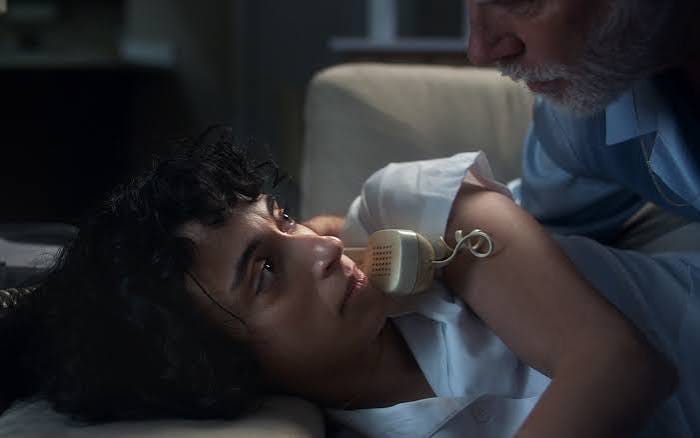
.Night Nurse, the debut feature from writer-director Georgia Bernstein, is a film even more bizarre than Gail Daughtry, though it takes its weirdness into far more unsettling areas. It begins with Eleni (Cemre Paksoy) interviewing for a position at a lavish retirement community under the supervision of Doctor Mann (Mimi Rogers). After an extremely cursory interview, she is hired and given the task of serving as the night nurse for Douglas (Bruce McKenzie), a man diagnosed with early-onset dementia whose previous evening caretaker quit after he supposedly mistake her for his wife one night and got grabby. Before long, however, Eleni makes the discovery that not only is Douglas’s illness apparently an act, he and his daytime nurse, Mona (Eleonore Hendricks), are running a phone scam on their fellow residents in which she pretends to be a granddaughter in trouble and he poses as a lawyer willing to help her for a hefty fee. If that weren’t enough, the two are also engaged in a sexual affair of sorts, one that is admittedly somewhat hampered by his age. One night, Douglas forces Eleni to play the granddaughter role for a call and gets such an erotic charge out of the situation that she quickly becomes his latest collaborator/lover. The twist is that she gets so into it that the power dynamic between them begins to shift as she takes an increasingly dominant role in her relationship with the much older man that she is ostensibly supposed to be taking care of, pushing them in increasingly risky and dangerous ways.
Make no mistake, Night Nurse is a very weird movie—an overheated stew blending observations about sexual manipulation, mistreatment of the elderly and gender dynamics within a framework that pays subtle homage to the old school erotic thrillers that overloaded video store shelves back in the day, albeit in ways that no character portrayed by the likes of Shannon Tweed/Whirry ever quite faced. It is so odd, in fact, that I suspect that the combination of these elements along with its willful denial of anything resembling plausibility and the discomfiting nature of most of the sexual material, will put a lot of viewers off early on. Sure, the narrative doesn’t exactly make much sense and the shift from dreamy ambiguity to something closer to standard thriller tropes in the final scenes doesn’t quite work. However, Bernstein establishes the odd and erotically charged atmosphere right from the start, maintaining it in all of it hazy and twisted glory throughout—a considerable accomplishment in this era when anything remotely smacking of sexuality in a film gets raked over the coals and even more considering that it all takes place in a nursing home. She gets a lot of help in this regard from her two leads, who combine to create a believable portrait of power and desire that cuts through the inherent lunacy of the premise and gives the film the kind of charge that films like the similarly BDSM-curious Babygirl never quite manage to establish in a convincing manner. As I said, Night Nurse is not a film for everyone (there is an extended surreal party sequence in the middle with Douglas lording over a number of nurses like a sultan making a drop-in at his harem that is likely to annoy many viewers). However, those who do spark to its seductive brand of strangeness will probably come out of it feeling disturbed, aroused and eager to see what Bernstein does for her next film.