
The Archer
My thoughts on The Odyssey

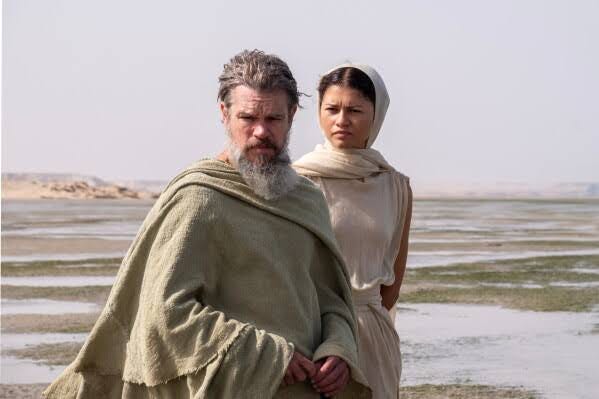
For those who keep track of such things, this summer’s cinematic box-office derby has proven to be somewhat unusual, to say the least with seemingly pre-ordained blockbusters like The Mandalorian and Grogu, Supergirl and Moana failing to live up to expectations while such out-of-nowhere low-budget titles as Obsession and Backrooms continue to pull in stratospheric grosses. As a result, the arrival of The Odyssey, Christopher Nolan’s eagerly anticipated take on the epic poem by Homer, takes on an even greater metaphorical significance. Already looked upon as the season’s 1600-pound gorillas amid all the other 800-pounders—the kind of film that, like Nolan’s last film, Oppenheimer, could bring in both a billion dollars and a slew of Oscars—it now feels like the current studio system’s last stand against these pesky little upstarts by giving audiences an abundance of what these smaller efforts can’t, from an all-star cast to visual splendors captured entirely by IMAX cameras, all paid for by a staggering budget.
This is a lot of weight to put on any one movie, even one whose shoulders are as broad as this, and that isn’t even factoring in all of the various and largely bewildering controversies that it has inspired online from everything from certain casting decisions to questions of historical accuracy—historical accuracy in the context of a fictional narrative that also includes such things as a giant cyclops wreaking havoc at one point. Having seen it, I find myself somewhat divided in how to respond to it. As a capital-E Event, it is a triumph—an unabashed throwback to the cinematic epics of old that has been put together with uncommon technical precision and skill on a scale that makes most contemporary spectacles seem puny by comparison, is filled with good performances from its uncommonly strong cast and top-notch contributions from its equally impressive array of behind-the-scenes talent. As a film, on the other hand, it is a bit wanting at times. Although it is well-made and does a good job of holding audience attention over the course of its three-hour running time, there is never any real sense of passion at any point and since this is a story which is all characters driven by their passions—for everything from the usual desires for power and revenge to the universal desire to be reunited with loved ones—the result is a certain hollowness at its core that no amount of spectacle can quite manage to overcome.
For those who are somehow unfamiliar with The Odyssey, it takes place almost twenty years after Odysseus (Matt Damon), king of Ithaca, set off with his men to fight in the Trojan War, leaving behind his devoted wife Penelope (Anne Hathaway) and infant son Telemachus. However, when the story opens, it has been ten years since he brought that war to an end with the deployment of the fabled Trojan Horse (which, although not a part of The Odyssey proper, is depicted throughout the film in flashback form) and there has been no word from him or any of his men. Assuming that he is dead, a large group of loutish suitors, led by the vile Antinous (Robert Pattinson) and Polybus (Corey Hawkins), have taken up a near-permanent residence in his castle, consuming all their food and drink while waiting for Penelope to finally admit that Odysseus is coming back and choose a new husband who will sit on the throne of Ithaca, much to the chagrin of the now-grown Telemachus (Tom Holland), who is also in line to succeed the father that he has barely known and who sets off on a treacherous journey to see if he can get a definite word regarding his fate. For her part, Penelope vaguely agrees to choose someone as soon as she has complete the weaving of a shroud for her father-in-law but, secretly convinced that her love is still out there, takes it apart every night in order to forestall things for as long as possible.
Of course, Penelope’s hunch is accurate and Odysseus is alive but when we see him, he has washed ashore on a remote island, seemingly lost his crew, his way and even his memory, where he is nurse back to health by the nymph Calypso (Charlize Theron). As fragments of his memory begin to return, he starts to recount what happened to him and his men to Calypso as their triumphant journey home turned into one catastrophe after another. On one island, they run afoul of a giant cyclops and, after being held prisoner, eventually manage to escape by blinding it. Alas, their captor is none other than a son of the god Poseidon, who makes sure that they are constantly hit by rough seas. As they continue on, the numbers of Odysseus’s men dwindle further after encounters with giant cannibals, sirens who lure some to their deaths with their enticing song, the multi-headed monster Scylla and, perhaps most frightening, Circe (Samantha Morton), who initially appears to be nothing more than a woman living alone who is surprisingly willing to give the men food and drink, only to eventually prove to be a little more than that. If that wasn’t enough, on another island, the men ignore Odysseus’s admonition not to eat the cattle living there—cattle which belong to the god Helios—and that move dooms all but Odysseus, who then lands on the island with Calypso. For a while, he is content to simply lay on the beach and eat lotus flowers with her but as peaceful as that seems, he still has the nagging sense that something is missing and when it all comes back to him, it leads to the finale in which Odysseus returns home in disguise in the hopes of settling scores and reuniting with his loved ones at last, despite his fear that they have moved on from him in the interim.
Although Nolan’s screenplay does make a few alterations to the original text—streamlining a few elements, adding and subtracting a couple of characters and reconfiguring the dialogue into a more contemporary form of English that allows, among other things, perhaps a few more F-bombs than Homer included in his version—the basic narrative is more or less the same and manages to work most of the key elements and players into it: besides those already mentioned, the film also includes Lupita N’Yongo as both Helen of Troy and her twin sister Clytemnestra, Zendaya as the protective goddess Athena, Benny Safdie as the doomed commander Agamemnon, Jon Bernthal as his brother/Helen’s husband Menelaus, the king of Sparta, Mia Goth as a treacherous maidservant, John Leguizamo as Odysseus’s faithful servant Eumaeus, Elliot Page as one of the soldiers under Odysseus’s command and rapper Travis Scott as a bard recounting the tale of the Trojan horse. Even for a movie as long as this one, that is a lot of people to keep track of and while a few end up getting a bit lost in the shuffle (I would have liked to see more from N’Yongo and Zendaya), Nolan does a pretty good job of keeping all of these plates spinning and the actors all rise to the occasion with nifty performances—my favorites are probably the ones give by Hathaway, who brings a quiet but intense fierceness to her depiction of Penelope and her refusal to give up hope, Pattinson, who is clearly having a blast as the most appalling of her would-be suitors, and Morton, whose work as Circe is so striking that her sequence proves to be arguably the most memorable of the entire film. (The only real distraction is Leguizamo, whose performance as the blind Eumaeus is technically fine but somewhat undone by a makeup job that makes him look disconcertingly like Marlon Brando in his late-60s nadir.)
At the same time, Nolan has pretty much taken this classic narrative and, through his telling, shaped it into a work that fits in perfectly with the rest of his oeuvre. As has been the case with the majority of his previous films, he messes a bit with the time structure, this time as a way of infusing added layers of meaning to the material for additional dramatic impact in certain scenes where we in the audience know more about what is happening than the characters themselves, particularly in Odysseus’s dealings with Calypso. It can also be seen as a reworking of some of the themes that Nolan tackled in a more contemporary setting in Oppenheimer—both films feature men who create weapons that bring long-standing wars to decisive conclusions, only to find themselves haunted by the memories of the unexpected costs of what they have done. From a technical standpoint, it is as stunning as anything that he has ever presented before as regular Nolan collaborator Hoyle van Hoytema’s IMAX cameras capture one stirring image after another. (Trust me, this is not the kind of film you want to hold off on until it hits streaming). There are also impressive contributions from other frequent members of Team Nolan like editor Jennifer Lame, who helps to keep the sprawling story from going off the rails, production designer Ruth De Jong and composer Ludwig Goransson, who helps to drive things along with another offbeat-but-striking score.
And yet, for all the obvious ambitions and incredible talents behind it all, I came away from The Odyssey impressed on an intellectual level and dazzled in terms of the sheer spectacle of it all but not really feeling it on an emotional level. Part of this is the inevitable result of a narrative that is essentially little more than one ambitious set piece after another and which keeps its central couple separated for nearly all of its elongated running time. However, in nearly all of his past films (with the notable exception of Tenet), Nolan has found a way to get past his complicated narratives, complex time structures and startling set pieces to provide emotional centers that made even something as ostensibly chilly as Interstellar into something genuinely moving. For whatever reason, you just don’t get that here and since, as I suggested earlier, the story is at least in part about people driven to the ends of the world and beyond by their passions and emotions, the lack of those elements in terms of the film itself is more than a bit perplexing. It is just a little too stiff and stultifying at times to allow you to regard it as anything other than its technical accomplishments—in this way, weirdly enough, it most closely resembles the old school movie spectacles that this film is a clear descendant.
Make no mistake, The Odyssey is definitely worth watching, particularly if you are within traveling distance of a theatre presenting it in either IMAX or 70 MM. From a technical standpoint, it provides such an array of riches that even the biggest screens might struggle to contain them all and includes any number of moments that will leave even the most jaded of viewers wondering how they were accomplished without severely injuring a lot of people in the process. More importantly, it has been made with such care and precision that it will grab the attention of viewers right from the start and hold it for all three hours—yes, even those who inevitably bitch about the threat to their bladders when confronted with anything over two hours. The problem is that for all of its qualities, I felt an emotional distance from the material that I never got from such previous Nolan epics as Interstellar, Inception and even Oppenheimer and while that didn’t ruin the film for me, it does hurt it to a certain degree. Put it this way—I am glad that I saw it and I, despite my misgivings, do recommend that you do as well. However, if I need to watch a film version of The Odyssey again anytime soon, I will probably bypass this one and go to O Brother, Where Art Thou? instead.