
The Long Run
My thoughts on The Running Man

Originally published in 1982, Richard Bachman’s The Running Man was a short, spiky and unabashedly pulpy novel set in the hellish dystopian future of 2025 where an ordinary man, desperate to provide for his wife and ailing child, winds up on the nation’s most popular television show, a game show entitled The Running Man in which he has to evade being tracked and killed by the show’s hitmen for 30 days in order to win a life-changing amount of money. Even back then, the conceit of future worlds where real murder and violence has been commodified into mass entertainment spectacles was not exactly fresh—there were short stories like Robert Scheckley’s ‘The Seventh Victim” (filmed in 1965 as The 10th Victim), In Melchoir’s “The Racer” (filmed in 1975 as Death Race 2000) and William Harrison’s “Roller Ball Murder” (filmed in 1975 as Rollerball)—and while the story was told in a sharp, punchy manner (it was supposedly written in only 72 hours) and had an impressively bleak finale, it is likely that it would have gone the way of most largely unheralded genre novels if it weren’t for the discovery a couple of years later that “Richard Bachman” was actually a pseudonym for none other than mega-author Stephen King.
This led to instant best-seller status and its own film adaptation in 1987, a project that bore little resemblance to its source other than the title and a vaguely similar premise—to name but one example, the Everyman hero at its center was now played by none other than Arnold Schwarzenegger. Overall, the film was not particularly good—original director Andrew Davis was fired a couple of weeks into production and replaced by Starsky himself, Paul Michael Glaser (Davis would go on to make a slightly more notable man-on-the-run story a few years later in The Fugitive)—and would most likely be completely forgotten today if it weren’t for the presence of actual game show stalwart Richard Dawson as the host of the show-within-the-film that proved to be a genuinely inspired bit of casting. In the years since the release of the original Running Man, many others have played with the concept of slaughter and sadism presented to audiences as entertainment, usually with full government approval, including the remakes of Death Race 2000 and Rollerball, the hugely popular Hunger Games franchise and Squid Game, the latter proving so popular that the fictional contest at its center was eventually turned into a genuine (if hopefully less deadly) reality competition series.
As a result of the success of these more recent examples, it was probably inevitable that someone would attempt to take another shot at bringing King’s novel back to the screen and now, in the year 2025, we have a new version of The Running Man in the form of a elaborate, over-the-top action spectacle brought to you by director/co-writer Edgar Wright. While it is certainly better than the 1987 version, the problem is that in transforming the material into a slickly made action piece, Wright seems determined to ignore both the more overtly nihilistic elements on display in the original book as well as the uneasy parallels between the vision of the future conjured up by King and the world that the film is now being released into. The result is well-made but completely forgettable—the kind of movie that you take away nothing from afterwards other than the taste of the popcorn you ate while watching it unspool.
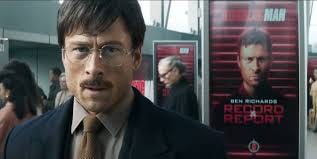
The film is sent in a vaguely futuristic authoritarian state in which the haves have pretty much everything and the have-nots have even less than they do now. Among the latter is Ben Richards (Powell), an ordinary guy unable to find a job after repeated firings for “insubordination” who is desperate for money when his adorable young daughter takes ill. This leads him to the offices of the military-entertainment complex behind any number of mind-numbing game shows in which desperate people are pushed to their limits in the hopes of making a few quick bucks. Although hoping to land on one of the less brutal offerings, Ben’s rebel attitude catches the eye of sleazy producer Dan Killian (Josh Brolin) and he, along with fellow applicants Laughlin (Katy O’Brian) and Jansky (Martin Herlihy), are recruited for the network’s most popular show, The Running Man, in which contestants are sent out into the world for 30 days trying to avoid both the show’s appointed hit men, led by the masked and mysterious Evan McCone (Lee Pace), and members of the public who would cheerfully rat out his whereabouts for a reward. For every day he lasts, he earns more money and if he manages to go the full length, he will pocket a billion dollars.
With no real choice and with assurances that his wife and daughter will be taken care of, Ben agrees to do it and, after being introduced to the public by the show’s slick host Bobby Thompson (Colman Domingo), he hits the streets running, initially adopting a number of disguises in the hopes of riding things out as long as he can without getting into any conflict. Not surprisingly, that doesn’t last very long and he soon finds himself being vigorously pursued by the show’s goons. In his struggles to keep going, he enlists the aid of an old friend (William H, Macy), a couple of conspiracy theorists (Daniel Ezra and Michael Cera) who are convinced that the network is not playing fair with the show’s contestants, and a bystander named Amelia (Emilia Jones) who fully buys the corporate propaganda presenting Ben as a soulless mass killer until he takes her hostage and she gets an eye-opening glimpse at what is really going on. As the days go on, Ben becomes a folk hero among the downtrodden who become increasingly convinced that this guy from the streets just might make it—a notion that Killian and others at the network are happy to milk in the knowledge that his success means higher ratings before the must-see season finale.
As I said, this version of The Running Man is certainly an improvement over the previous film. For those who are concerned about such things, the narrative certainly hews closer to the original novel, especially during the first half of so and Wright and co-writer Michael Bacall do make an effort to inject some human dimensions into supporting characters who were once little more than caricatures. As our increasingly frazzled regular guy, Powell is a much better fit for the role than Schwarzenegger and some of his disguise play in the early going comes across like an amusing riff on his work in Hit Man, the film he did last year with Richard Linklater that you should go off right now and watch if you haven’t already. And as he previously demonstrated in Baby Driver, Wright does know how to put together a big action sequence in a manner that is wildly propulsive and energetic as can be while at the same time demonstrating a visual coherence that is becoming increasingly rare these days.
And yet, for all of these efforts, The Running Man proves to be a largely hollow experience—the kind that you struggle to remember anything about the morning after watching it. There is nothing particular new or clever to this particular take on the familiar material and when it does hit upon an intriguing idea, it seems determined to cast it to the side—while Powell is just fine here, Katy O’Brian is so striking in her comparatively few moment that it makes you kind of wish that she had be given the central role. For all of its apparent surface outrages, Wright is too busy stuffing the film with various King-related in-jokes and homages to favorite filmmakers to do anything that might challenge viewers in regards to their own lust for violent entertainment or anything else for that matter. At first, the film seems to be leaning towards acting as social commentary by using the premise as a way of satirizing these particularly peculiar times but the few jabs are largely toothless (the audiences we see watching the show are virtually indistinguishable from the types seen at MAGA rallies) and are pretty much abandoned in the second half as the spectacle aspect completely takes over. And while I recognize that the memorably bleak ending to King’s original book simply could not be done as written without raising a lot of hackles, the conclusion that Wright deploys here is such a cop-out that it essentially nullifies everything that preceded it.
The Running Man has been made with undeniable style and skill and if all you are looking for is a slick, noisy bloodbath, you could certainly do worse than this. However, to see a once-distinctive filmmaker like Wright doing something as utterly anonymous as this is a tad depressing—at no point do you get any of the sharp commentary or genre deconstruction that have played parts in his more memorable early efforts. It takes no chances and does nothing to challenge its audience in the way that even a cheesy B-movie like the original Death Race 2000 (which had a happy ending that—Spoiler Alert—involved the assassination of the U.S. President) was willing to do back in the day. Essentially, Wright has made the kind of soulless, unchallenging and hyper-violent extravaganza that the programmers at the network at its center would screen in heavy rotation without a moment’s hesitation.