
The New World
My thoughts on Predator: Badlands

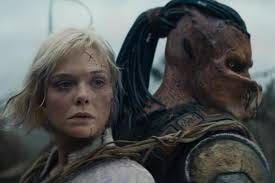
Predator: Badlands is a film that contains a pretty good and inspired idea at its core. This may not sound like a lot but considering that it is a film that marks, depending on how you count the various off-shoots that have appeared over the years, either the sixth or ninth entry in a franchise that has been running for nearly forty years, the presence of such a thing at such a late date is a welcome surprise. The trouble is that the one good idea is quickly joined by about sixteen additional ones that run the gamut from the mediocre to the truly dumbfounding. The result is certainly not the worst Predator film by any stretch of the imagination—not even if you remove the Alien vs Predator spinoffs from the equation on the basis that they barely count as movies at all—but it might go down as the most frustrating of the bunch because of the way that it squanders that initial idea with a lot of nonsense.
The film starts off on the remote home planet of the Yautja, a fierce band of warriors that you might know under a different name, as young Dek (Dimitrius Schuster-Koloamatangi) is training under the tutelage of his tough-but-loving brother Kwei (Mike Homik) for his first hunt, where he hopes to finally win the respect of his father, Njohrr (also played by Schuster-Koloamatangi), who happens to be the literal apex Predator of their clan. Although Dek is determined to prove himself, Kwei knows that he is not ready but nevertheless defends him to their father when he arrives, dismisses Dek as an embarrassment to their family and orders Kwei to do to him what one typically does to the runt of the litter. Instead, Dek takes off for a distant planet that is the home of the Kalisk, one of the most fearsome creatures in the universe and one that no Yautja has ever been able to defeat, in the hopes of taking one down and bringing it back as an intergalactic FU to dear old dad.
Although these opening scenes are not particularly unique from a dramatic perspective, they do make for a marked change in approach for a Predator film. For the first time, humans are not part of the equation and the Predators themselves take center stage, even to the point where their dialogue is spoken in a made-up Yautja language and accompanied by subtitles. It is an intriguing move for the franchise to make and helps bring a certain freshness to material that might have come across as a bit stale otherwise. Once Dek lands on the planet, the fascination continues as he becomes acclimated with his new surroundings and quickly realizes that practically everything around him is apparently determined to kill him in the nastiest ways imaginable. At this point, even though I have never exactly been a huge proponent of the Predator franchise as a whole—the only ones I have liked were the reasonably inspired 1987 original with Arnold Schwarzenegger and the genuinely inspired 2022 entry Prey, which found a young Comanche woman circa 1719 doing battle with a visiting Predator—it seemed as this might be the rare legacy sequel of late that might actually work.
Alas, it is at this precise point that someone clearly must have lost their nerve over the idea of presenting a film chronicling a Predator hunt entirely from the perspective of one of the Predators without any type of human interloper—perhaps a sci-fi version of those old wildlife movies that Walt Disney used to release back in the day—and instead seem to go out of their way to make the proceedings more familiar and ultimately less interesting. Dek soon comes across Thia (Elle Fanning), a damaged synthetic produced by Weyland-Yutani, the shadowy corporation at the center of the Alien franchise that is still chirpy and chatty despite only being an upper torso, and it convinces Dek to take her along along on his journey so that she can supply both a familiar face for moviegoers and dialogue that doesn’t need to be subtitled. Before long, they come across an adorable-but-deadly little creature that tries to attach itself to Dek, who prefers to be a loner. If that weren’t enough, it turns out that Weyland-Yutani has an entire base populated solely by synthetics, including Thia’s “sister” Tessa (also Fanning), who are also there to try and capture the Kalisk in the hopes of using its regenerative capabilities to help with their biotech developments, having apparently decided to put xenomorph research on the back burner for the moment.
Predator: Badlands was directed by Dan Trachtenberg, who previously did both the aforementioned Prey and this year’s animated offering Predator: Killer of Killers, a film that others liked more than I did but which also demonstrated a certain admirable ambition. I get and appreciate that he is trying to find different approaches to the Predator franchise to keep it from running into the ground as it did the first time around with sequels so forgettable that hardly anyone remembers these days. (Hell, Adrien Brody was in one of them and he may not even remember it.) The problem here is that the narrative supplied by screenwriter Patrick Alison is one that is both all too familiar (there are bits and pieces reminiscent of everything from The Outlaw Josey Wales to Shrek to The Mandalorian) and one that goes out of its way to take the basic ethos of the central character—a relentless warrior who lets nothing get in the way of his goals—and erases it as he becomes the increasingly sentimental head of the ad-hoc family that he assembles for himself over the course of the film. It just feels off and antithetical to what one might rightfully expect from a Predator film—it is like what might have resulted if someone tried to transform the franchise into a syndicated animated show. Adding to that sensation is the perhaps ill-advised decision to take a series known for rough, brutal action and soften it in order to get a PG-13 rating—I’m not saying I necessarily need to seed gallons of viscera being spilled but there is a certain lack of tension in watch a representative of what is supposed to be the greatest warrior race in the universe laying waste to a bunch of robots.
Predator: Badlands does have a couple of pleasures on hand to be had. Elle Fanning is clearly having a lot of fun in her dual role—the loopier Thia suggesting that Weyland-Yutami offer a Manic Pixie option on their synthetics while her turn as the colder and crueler Tessa seems that she is channeling her own real-life sister, Dakota, at times. From a visual standpoint, the film is fairly impressive throughout, particularly our first glimpses of the alien planet and its universally deadly array of flora and fauna. (That said, some purists may object to how CGI has been utilized to augment the familiar Predator visage in an effort to further humanize him.) Also, it it far from being the worst Predator film and it might indeed be ideal for younger viewers who have a taste for sci-fi, action and monsters but who are not quite old enough to see full-strength iterations like the original or Prey. Frankly, if this movie had been made a decade or so ago, I might have found myself praising it for being a step up from most of its predecessors. However, in the wake of a film as fascinating and exciting as Prey (whose bypass of the theatrical market in order to premiere on Hulu is certain to go down as one of Hollywood’s most colossal mistakes of the decade), I was frankly expecting a equally unique take here, especially considering that it came from the same filmmaker, and I just didn’t get it here. Prey was a film that felt as if it sprang from a single, unified vision and was all the better for it. Predator: Badlands, on the other hand, feels like something assembled by a committee determined to overload it with supposedly crowd-pleasing elements that only serve to distract from the interesting initial setup and to prove once again that even in space, too many cooks can still spoil the broth.